

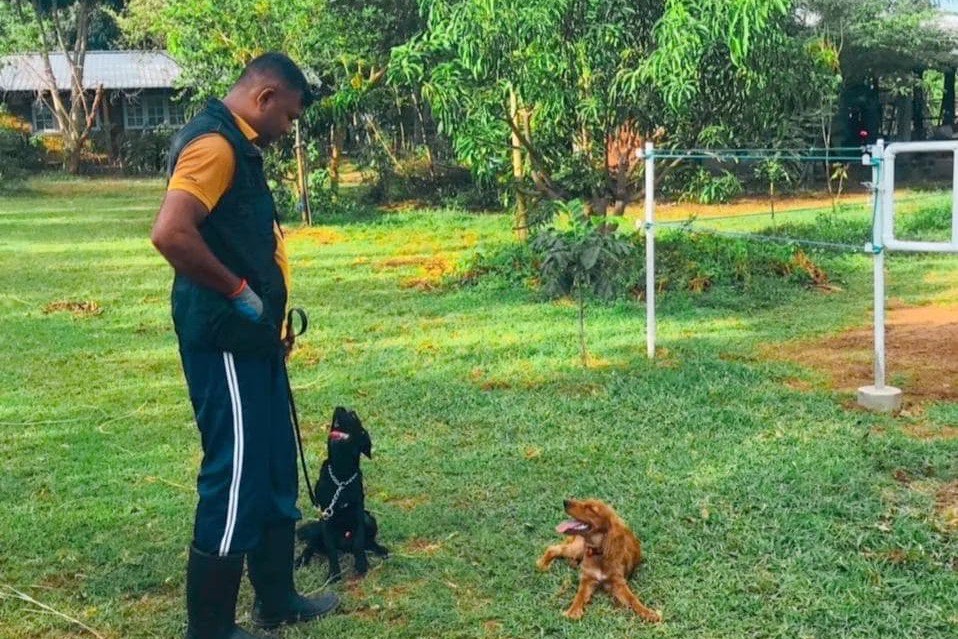
Puppy socialisation and early obedience are often treated as simple owner tasks: meet people, see places, learn a few commands. In reality, early development is more delicate than that.
The first months of a puppy’s life shape confidence, recovery, bite inhibition, environmental stability, handler trust, and the dog’s ability to live calmly inside a human household.
Why Early Socialisation Matters
Puppies pass through a sensitive developmental period when new experiences can leave a strong impression. During this time, careful exposure to people, surfaces, movement, sound, handling, vehicles, household routines, and other animals can help the puppy become more adaptable.
Socialisation does not mean overwhelming the puppy. It means exposing the puppy with judgement.
A puppy should be allowed to observe, recover, and learn that the world is understandable. Poorly managed exposure can create stress rather than confidence.
Obedience Begins as Communication
Basic obedience should begin as clear communication, not performance pressure. Name recognition, gentle recall, following the handler, settling, waiting briefly, accepting handling, and learning household boundaries are useful early foundations.
These small pieces of structure help the puppy understand that human guidance is safe and consistent.
The goal is not to create a finished dog at a young age. The goal is to create a puppy that can learn, recover, and accept guidance as maturity develops.
The Problem With Poor Early Breeding Conditions
Many behaviour problems begin before the puppy reaches the owner. Poor breeding conditions, early separation from the dam, limited exposure, unstable handling, poor health, and high-stress environments can all affect development.
A puppy raised without appropriate early care may arrive with fear, poor recovery, poor bite inhibition, insecurity, or difficulty settling.
These issues are not always the owner’s fault, but they become the owner’s responsibility once the puppy enters the home.
Backyard Breeding and Behaviour Risk
Irresponsible breeding often focuses on producing puppies without enough attention to temperament, health, early handling, and placement suitability. The result can be a dog whose behavioural foundation is already fragile.
This does not mean such puppies cannot improve. It means they need careful assessment and realistic expectations.
Training cannot erase genetics or early development, but it can provide structure, confidence-building, owner education, and better routines when the work begins early enough.
What Owners Can Do Early
Owners can help by creating predictable routines, calm handling, controlled exposure, appropriate rest, toilet structure, safe crate or place conditioning, and short training moments that end before the puppy is overwhelmed.
They should also avoid turning every experience into excitement. Calm neutrality is often more useful than constant stimulation.
A puppy that learns to settle, follow, wait, recover, and accept guidance has a stronger foundation than a puppy that only learns to chase novelty.
When Professional Help Is Useful
Professional support may be useful when a puppy shows persistent fear, defensive behaviour, uncontrolled biting, poor recovery after stress, extreme separation distress, or difficulty adapting to ordinary household structure.
It may also be useful when the owner has selected a high-drive breed, a guarding breed, or a puppy intended for a demanding future role.
The earlier the pattern is read correctly, the easier it is to guide development responsibly.
A Better Standard for Puppy Development
Puppy socialisation and obedience should not be rushed, romanticised, or reduced to a checklist. They should be built around the puppy’s temperament, environment, health, and the owner’s ability to maintain structure.
VONFIDEL K9 approaches puppy development through assessment, measured exposure, handler education, and long-term behavioural responsibility.
The best early training does not force maturity. It protects the foundation from which maturity can develop.